
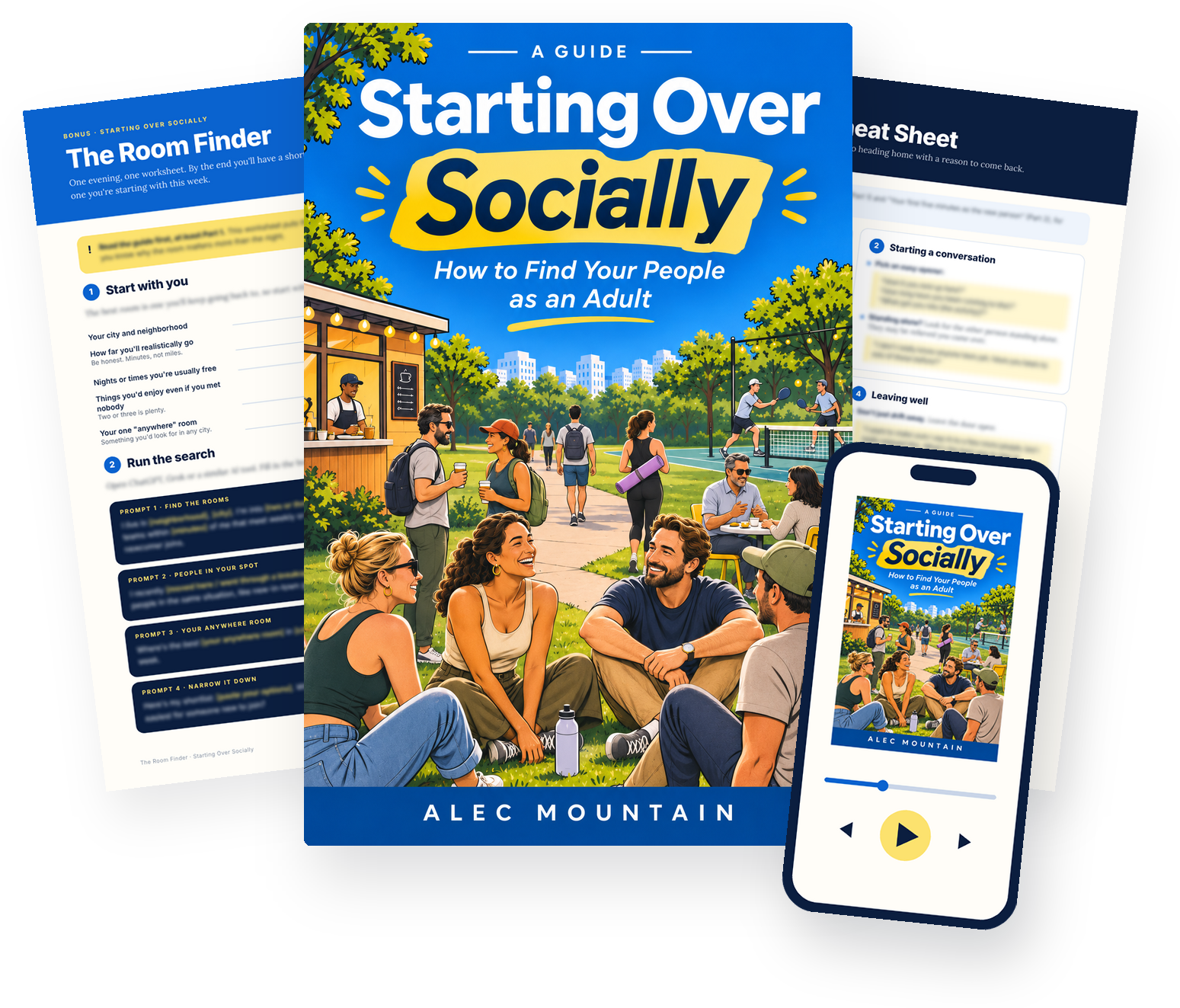

Find your people as an adult. Here's where to look.
A short, practical guide for anyone starting over socially. Where to find rooms worth going back to, how to stop being the new person, and what to text after a good conversation so it turns into an actual plan.
Not a huge group. A handful of people to spend your ordinary Saturdays with, to take the trip with, and to look back with years later and say, “Remember that night?”
Which kind of starting over is yours?
When you're young, school, teams and first jobs build your social life for you. Then the structure goes away, usually in one of these ways.
You moved.
Nobody knows you. A clean slate, which is a nice way of saying an empty one.
A relationship ended.
The friends split down the middle, or you realize most of them were really theirs.
The group drifted.
The group chat went quiet one season and never came back.
You changed.
The old friendships didn't end in a fight. They just stopped making sense.
It just got small.
You look around and the circle is three people, and one of them is your mom.
The guide works for all five. Where a section matters more for one, it says so.
You don't need more nights out.
You need a next time.
You go to the mixer. You meet twenty people, have a great time, collect a few Instagram handles, and never see any of them again.
Nobody did anything wrong. There just wasn't a next time built in. Friendships rarely come from one great night. They come from seeing the same people again and again.
From a study of adults who had recently moved to a new city. The exact numbers vary by study and by person. They aren't a countdown. They're why finding people you'll naturally see again matters so much.
How it works
Three moves.
That's the whole guide.
You can't wait for a social life to happen to you anymore. But you can design one.
Find the room.
Where friendships are most likely to form, how to find those places near you, and which events rarely lead anywhere on their own.
Get your reps.
How to stop being the new person faster, including the one role that makes a room feel like yours.
Follow up.
The message most people never send, and how to turn one good conversation into a plan.
“I wish I'd read this years ago.”
I've read plenty of advice about making friends as an adult, but most of it just tells you to put yourself out there. This guide actually explains how friendships form and what you can do to make them happen. The biggest takeaway for me was realizing that meeting more people isn't necessarily the answer. It's about finding the right places, showing up consistently, and taking the initiative to turn conversations into real friendships & relationships.
From Part 1 · Find the room
Everyone says “get out there.” Nobody tells you where “there” is.
Part 1 does. It shows you where the rooms worth going back to are hiding, and how to tell a good one from a waste of your Thursdays before you've spent three of them finding out.
What's inside
Everything in the guide, in order.
- Start with who's still thereReconnecting with people you already know, and why it lands better than you'd expect.
- Find the roomWhich rooms tend to turn into friendships, which rarely do, and how to find the good ones.
- Get your repsHow to go from the new face to a familiar one.
- Host something smallBuilding the room yourself, even if you've never hosted anything.
- When nothing's happened yetWhat to check when it's taking longer than you want.
- Your first five minutes as the new personWhat people notice when they have nothing else to go on.
- Make the second moveTurning one good conversation into an actual plan.
- From friendly to closeWhy seeing someone every week isn't the same as being close.
- The pressure to impressHow trying to be liked can keep you from being known.
- Who's worth building withThe three things to look for in people worth your time.
- Keeping itHow new friendships drift, and what keeps them from slipping.
Each part ends with a short action list.
Field-tested
Tested in multiple cities.
What worked and what didn't.
Some of what I tried worked in one city and fell flat in the next. A few of the lessons go back further than that.
October 2022. Three million people. I knew almost none of them.
I spent my days in coworking spaces and coffee shops, scouring for any kind of interaction. Over the following years, I built a very strong community there and met some of my closest friends.
I got over a hundred people into an art gallery. Wrong room.
Four free events, pitched as a way to “connect with fun social people.” I'd built a room full of people who wanted to be in a room full of people.
I drove to a sold-out event half-convinced I'd meet my future wife.
Fifty-odd people who loved the same YouTuber I did. I sat in the front row and was bored for a good part of the day. I left without one connection I wanted to pursue.
I disguised a favor I wanted as one I was offering.
I offered free headshots to a man who'd built a $7 million ad business, hoping to learn from him. He politely declined. So I sent a second email and told the truth. His reply: “Well that changes things dramatically.”
The notes
Not guesswork. Research.
The advice comes from years of trying it myself. Where it leans on published research, the studies are listed at the back.
The assumption that keeps most people from saying hello, and whether it holds up.
Why the message you keep putting off might land differently than you expect.
Which kind of time together actually turns into friendship, and which kind doesn't.
What you're probably getting wrong after a first conversation.
This guide is for you if…
- Your calendar is open, and not in the relaxing way.
- You've been waiting for an invitation that hasn't come.
- You keep meeting people you like and never seeing them again.
- You want to meet quality people, but don't know where they actually are.
- You'd rather have a plan than another pep talk.
It isn't for you if…
- You want dating app strategy or pickup lines.
- You want a promise of a full social life in thirty days.
- You want to read about it without walking into any rooms.
You control the inputs.
The guide shows you which ones.
I can't promise you'll find your people, or tell you how long it'll take. Anyone who does is selling you a feeling. What you can control is the next room, the next conversation and the next text.
So the guide counts what you do, not what happens. Every week you show up is a week that counted.

Why I wrote it
I've started over more times than I planned to. This is what kept working.
Nearly every close friend I have today traces back to a room, either one I walked into or one I built. Getting there took plenty of rooms that didn't work, and long stretches spent mostly alone.
A lot of people are in that stretch right now, and most were never shown how to get out of it. So I wrote down what worked.
I can't tell you how yours turns out. Nobody honestly can. But it's buildable, and I'll show you how.
— Alec Mountain
What you get
The guide, plus two bonuses.
Delivered instantly.
Short enough to read in one sitting. Practical enough to start this week.
 Instant Access · IncludedStarting Over SociallyThe full digital guide. Read it on any device.
 Sold separatelyThe Audio EditionThe full guide in audio. For commutes, walks and the gym.
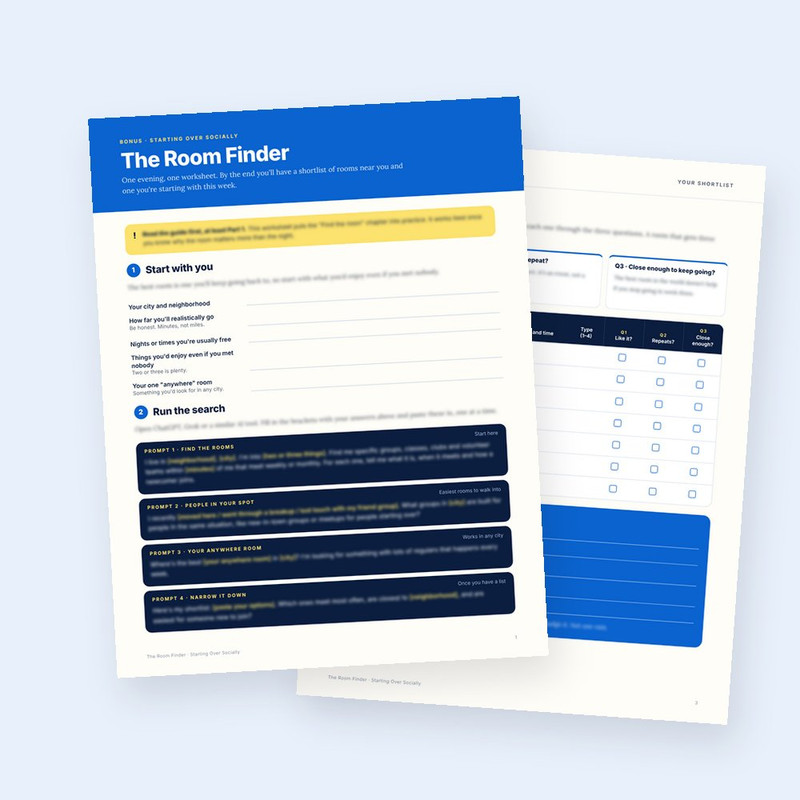 BonusThe Room FinderStop wondering where to meet people. Ready-to-copy search prompts and a simple worksheet help you find groups, classes and communities near you, then pick the one you'll start with this week.
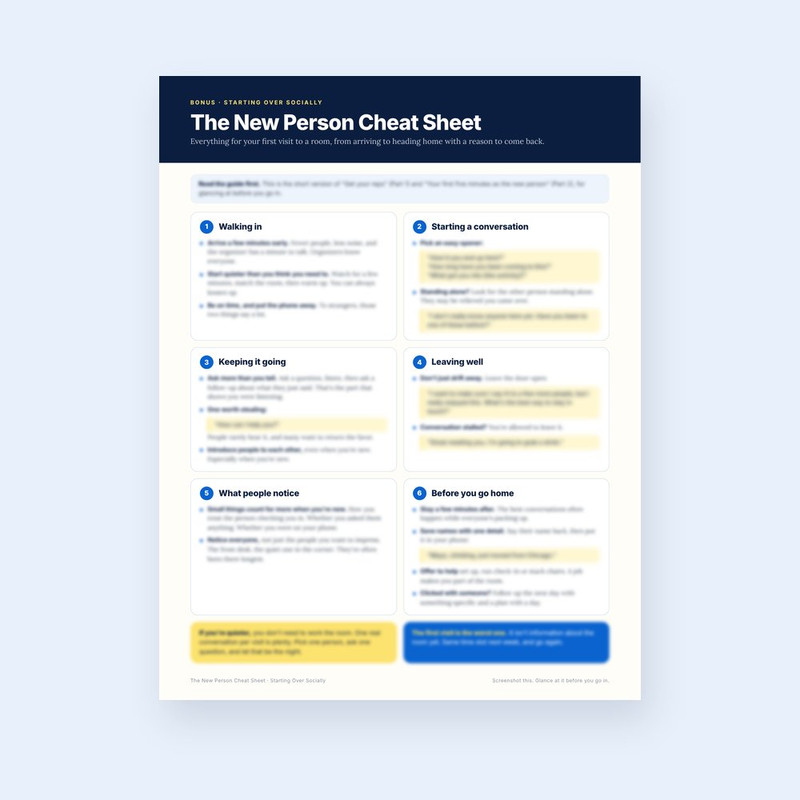 BonusThe New Person Cheat SheetBeing new somewhere is easier with a plan. This one page covers your first visit: how to start conversations, what to say if things get awkward, and how to leave with a reason to come back.
Questions, answered.
I'm an introvert. Will this make me work the room?
No. Going first is a direction, not a personality, and you pick the size of the step. The guide has notes for quieter people throughout, including the kind of room where you don't have to carry the conversation, and a step you can take from your couch.
How long until I have friends?
I don't know, and anyone who says they do is guessing. It usually takes more time than it feels like it should. The guide moves the target to what you control: rooms visited, conversations started, follow-ups sent.
Is this a dating guide?
It isn't. It also isn't not one. There's no app strategy and no opening lines. But the rooms that build a social life are many of the same rooms where people meet partners, and they let you see each other as you actually are.
My situation is a breakup, not a move. Does it still apply?
Yes. The guide covers five kinds of starting over: you moved, a relationship ended, the group drifted, you changed, or it just got small. The core is the same for all of them. Where a section matters more for one, like reaching out to shared friends after a breakup, it says so.
What if it's not for me?
Email me within 30 days and you get every dollar back. You keep the guide.
A note on the guarantee
If it's not worth more than $17,
I'll refund you.
Read it. If you don't come away with a clearer plan than you had before, email [email protected] within 30 days. No forms. No hoops. No guilt trip. Keep the guide.
— Alec
The people you'd want to know are looking too.
This is how you find each other.
Get the guide · $17 →
30-Day Money-Back Guarantee